
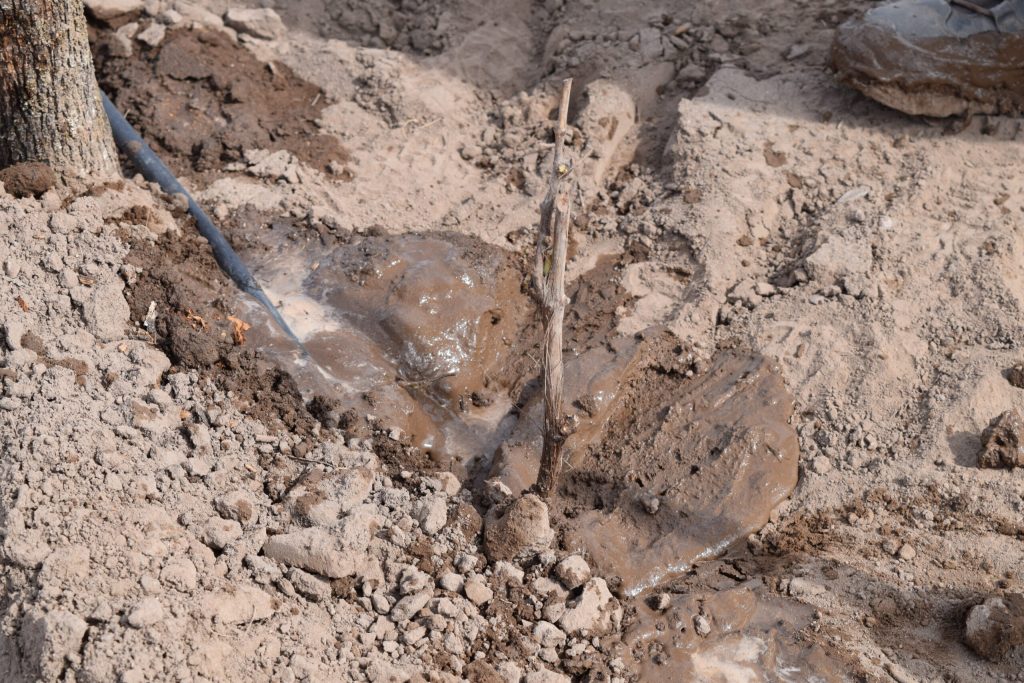
On Monday, Sept. 18th, 2017, after six years of struggle against all odds, we started planting vines in our Jardín Altamira estate. Turning a wild piece of land into a vineyard is no easy task, and its completion has required the utmost dedication of all the Altos Las Hormigas team.
One of the leaders in this major task has been our viticulturist, Juan José Borgnia, “Juanjo” for friends and family. We have asked Juanjo to tell us first-hand about his experience planting vines in one of the finest spots of the Uco Valley, Mendoza.

Juan José Borgnia, Agronomical Ingeneer at Altos Las Hormigas
I am 29 and this is my first experience planting a vineyard. The best part of this challenge is that Jardin Altamira will be like no other vineyard in Argentina; we actually believe that it will be the best vineyard in Argentina. It is a unique concept where terroir viticulture merges with the natural biodiversity of the area.
The first step was a study of the soil units, using an electro-conductivity mapping method. This tool helps identify areas with similar soil characteristics. We completed this study with a visual analysis of more than 50 soil pits across the estate, using Pedro Parra’s classification method.This study allowed us to create the terroir map of the estate, separating the different soil units and providing us with the guidance to select the best parcels for vineyard planting, and leaving the less suited areas untouched. This is the first project in Argentina where 35% of the estate was left with its native flora, mingled in between vineyards. These plots will work as biological corridors across the estate.
Our goal was to overcome the pattern of monoculture, an industrial-productive concept, aimed at maximizing fruit quantity and soil usage, which widely dominates Argentine and New World viticultures. We prepared the project of the vineyard lots (22 in total, ranging from 3.8 to less than 1 Ha each), we set up the vineyard trellis structures and we installed the drip irrigation system, crucial for the life of our plants!

The irrigation blueprint for Jardín Altamira
The different soil units will receive each a custom-tailored irrigation and farming regime, according to their structure, drainage, and water retention potential. This allows the development of a healthy and deep root system, the crucial feature of a great vineyard.
Juanjo also explains that the chosen training system for the vines was the high espalier with mobile wires, since it is the most used system when it comes to producing high-quality grapes. Some of its advantages are: it benefits the growth of the leaves, very important in sunny areas as Mendoza; it allows good exposure to light and aeration and it facilitates canopy management.

How was the weather during planting?
We had a complete set of… challenges. We suffered with a strong Zonda wind (dry wind from the Andes) when the first sprouts were appearing, which was followed by a frost that caused major damage in the region. And as the baby vines were beginning to recover from all this, there was a hailstorm that actually made us fear the worst!However, we did not get too many hot days –as we may have expected for a typical Mendoza springtime- and the plants are growing healthily.
What were the main challenges you found?
Uff! I believe the main “challenge” was Altamira itself. The huge stones that mark this area gave us quite a few headaches, from the very beginning when we were preparing the soil.

Jardín Altamira’s planting lasted 12 weeks, finishing on December 13th, 2017. From now on, it is important to keep a balanced humidity level in the soil to avoid vine dehydration. The management of the irrigation system is now critical, and more so considering Mendoza’s dry climate. It will also be crucial to keep weeds away from the baby vines, since the two species compete for water and light. Last but not least, we must organically protect the vines from diseases and plagues, particularly the Ants that we know so well can cause great damage to the buds and leaves.
Juanjo says that as the little buds start to grow, we will have to choose the best two or three in each plant, eliminating the others. By doing so, the vine’s nutrients will concentrate in the chosen buds and we will have strong plant development by the end of the season. During winter (June to September in Argentina), we will be pruning these vines for the first time.
After such a demanding job… What personal experience has this planting given you? What is the biggest satisfaction you got?